Choosing among China’s best Ultrapure Water Equipment manufacturers requires more than comparing prices or polished websites. The real test appears in cleanroom details, commissioning records, and long-term water stability. A reliable supplier should understand reverse osmosis, electrodeionization, ultrafiltration, UV oxidation, and final polishing. It should also explain how each stage protects resistivity, TOC, microbial control, and particle limits.
Dr. Joseph A. Cotruvo, a recognized water-quality expert, has stated, “Treatment must match the contaminants and the intended use.” That principle matters here. Semiconductor production, pharmaceutical manufacturing, laboratories, and medical facilities require different water specifications. A system designed for general laboratory use may fail under pharmaceutical validation demands. Small differences can become expensive problems.
This guide examines Chinese manufacturers through practical evidence. Look for factory experience, documented testing, responsive service, spare-parts availability, and compliance with relevant standards such as ASTM D5127, USP, SEMI, and ISO 9001. Ask for full P&IDs, material certificates, water-quality data, and installation references. Do not rely only on claimed production capacity.
Some brochures look impressive. Reality can be less tidy.
A strong manufacturer should measure performance after installation, not merely promise it before delivery. Operators should receive clear maintenance procedures, alarm explanations, and calibration support. Energy use also deserves attention, especially when the system runs continuously. The shortlist may never be perfect. Still, careful comparison can reveal which China-based Ultrapure Water Equipment suppliers offer dependable engineering instead of attractive marketing alone.
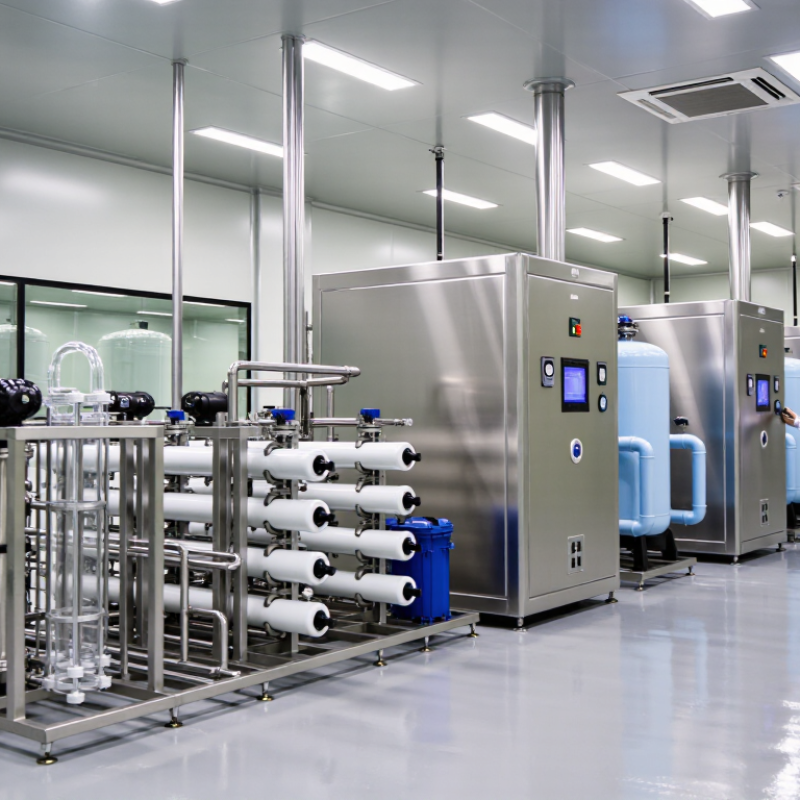
Ultrapure water equipment removes ions, particles, organic carbon, microbes, and dissolved gases. A typical system combines pretreatment, reverse osmosis, electrodeionization, ultraviolet oxidation, and final membrane filtration. Its goal is not simply “clean water.” It creates stable water for sensitive processes.
ASTM D5127 defines ultrapure water quality using measurements such as resistivity, total organic carbon, particles, and bacteria. At 25°C, high-grade water commonly reaches 18.2 megohm-centimeters resistivity. Pharmaceutical facilities also reference USP <1231>, which emphasizes microbial control and continuous monitoring. The U.S. EPA WaterSense at Work report notes that reverse osmosis recovery often ranges from 50% to 80%. Poor recovery can increase wastewater and operating costs.
Semiconductor plants use ultrapure water to rinse wafer surfaces without leaving ionic residues. Laboratories need it for chromatography, spectroscopy, and reagent preparation. Pharmaceutical production requires controlled water because small contaminants can affect safety and test results. However, a perfect conductivity reading proves little by itself. Organic carbon, bacteria, and particles may still remain. Operators should verify sensors, sanitization records, storage tanks, and return-loop temperature. Chinese equipment manufacturers should therefore provide traceable test data, validation documents, and practical maintenance support. No system stays perfect. Water quality can drift after installation, especially when monitoring is treated as paperwork rather than daily process control.
Choosing among China’s ultrapure water equipment manufacturers requires more than comparing quotations. Start with the water specification: resistivity, TOC, microbial control, flow rate, and recovery. A competent manufacturer should explain how pretreatment, RO, EDI, UV, and final filtration work together. Ask for a process flow diagram. Request material certificates for wetted components, especially stainless steel, membranes, valves, and storage tanks. Technical language should match the intended laboratory or production use. If the supplier promises laboratory-grade water without discussing feed-water variation, remain cautious.
Experience appears in details that brochures often omit. During a factory audit, inspect assembly areas, pressure testing records, electrical panels, and cleanliness controls. Ask for recent installation references with similar capacity and feed-water conditions. Independent verification matters. Review calibration certificates, factory acceptance testing, site acceptance testing, operating manuals, and maintenance schedules. Reliable teams also provide operator training and respond with defined service times. Vague answers about replacement intervals may signal weak after-sales planning.
Authority is not just a certificate on a wall. Check applicable quality systems, export documentation, electrical conformity, and water-quality test methods. Request test results from recognized laboratories when critical specifications are involved. Compare proposed performance with actual operating costs, consumables, energy use, and wastewater volume. A low purchase price can hide expensive filter changes or difficult local support. I have seen technically elegant systems underperform because users skipped commissioning checks. That mistake is easy to repeat. Leave room for doubt, and put every performance promise into the contract.
| Evaluation Dimension | Recommended Benchmark | What to Verify | Why It Matters |
|---|---|---|---|
| Product Water Quality | For laboratory Type I applications, resistivity of approximately 18.2 MΩ·cm at 25°C and low organic, microbial, and particulate levels are commonly expected. | Independent water-quality test reports, operating specifications, online monitoring functions, and defined acceptance criteria. | Stable water quality is essential for sensitive analytical, molecular biology, pharmaceutical, and semiconductor processes. |
| Purification Process | A suitable combination of pretreatment, reverse osmosis, deionization or electrodeionization, UV oxidation, ultrafiltration, and final filtration according to feed-water conditions. | Process-flow diagram, component specifications, consumables list, and protection measures for each purification stage. | A properly designed process improves reliability, protects the final polishing unit, and reduces operating costs. |
| Feed-Water Adaptability | The equipment should be selected using actual feed-water parameters, including conductivity, hardness, silica, chlorine, temperature, pressure, and microbial load. | Feed-water analysis requirements, pretreatment design limits, and documented performance under local water conditions. | Incorrect feed-water assumptions can cause membrane fouling, resin exhaustion, corrosion, and unstable output quality. |
| Standards and Compliance | Design and documentation should be aligned with applicable references such as ASTM D5127, USP <1231>, European Pharmacopoeia requirements, or project-specific standards. | Declaration of conformity, test methods, calibration records, validation documents, and quality-management certification where applicable. | Relevant standards make performance claims measurable and support regulatory or quality audits. |
| System Capacity | Capacity should match actual peak demand, operating hours, storage volume, circulation requirements, and future expansion plans rather than only nominal daily output. | Flow-rate curves, recovery rate, peak-load calculations, storage-tank sizing, and redundancy options. | Correct sizing prevents shortages, excessive equipment cycling, unnecessary energy use, and quality degradation during low demand. |
| Monitoring and Control | Continuous or scheduled monitoring should cover key parameters such as resistivity or conductivity, temperature, total organic carbon where required, pressure, flow, and leak status. | Sensor accuracy, calibration interval, alarm settings, data logging, access control, and communication protocols. | Good monitoring helps detect quality drift before it affects experiments or production. |
| Sanitary Design | Product-water pathways should minimize dead legs, stagnation, particle release, and microbial growth; materials should be compatible with purified water service. | Piping layout, tank design, recirculation strategy, drainability, material certificates, and sanitization procedures. | Hygienic design reduces biofilm formation and helps maintain microbiological control. |
| Energy and Water Efficiency | Compare specific energy consumption, reverse-osmosis recovery, reject-water use, standby consumption, and the expected replacement frequency of consumables. | Measured operating data, recovery calculations, utility requirements, and life-cycle cost estimates. | Utility efficiency affects both environmental impact and long-term ownership cost. |
| Installation and Commissioning | The supplier should provide installation drawings, utility requirements, commissioning procedures, operator training, and site-acceptance testing. | Factory-acceptance and site-acceptance test protocols, commissioning records, training materials, and handover documents. | Professional commissioning reduces start-up problems and establishes a documented performance baseline. |
| Maintenance and Consumables | Routine maintenance should be clearly defined for pretreatment filters, membranes, cartridges, UV lamps, sanitization, sensors, and polishing media. | Maintenance schedule, replacement criteria, spare-parts availability, service response process, and consumables compatibility. | Predictable maintenance improves uptime and prevents avoidable quality failures. |
| Documentation and Validation | A complete documentation package should include user requirements, functional specifications, manuals, drawings, certificates, calibration records, and test reports. | Document index, revision control, traceability of critical components, and qualification support such as IQ, OQ, or PQ when required. | Traceable documentation supports quality management, troubleshooting, and regulatory inspections. |
| After-Sales Support | Evaluate technical support coverage, response procedures, spare-parts logistics, remote diagnostics, warranty terms, and local service capability. | Written service-level commitments, escalation contacts, warranty exclusions, and evidence of support for comparable applications. | Reliable support reduces downtime and helps preserve water quality throughout the equipment life cycle. |
| Total Cost of Ownership | Compare purchase price together with installation, utilities, consumables, preventive maintenance, calibration, wastewater, validation, and expected replacement costs. | Five- to ten-year life-cycle cost model with assumptions stated clearly and separately from the initial quotation. | The lowest initial price does not necessarily represent the lowest operating cost or best value. |
Note: Final specifications should be selected according to the application, feed-water analysis, required water grade, applicable regulations, and validated operating conditions.
China’s ultrapure water equipment manufacturers are moving beyond basic reverse osmosis units. Many now integrate pretreatment, RO, electrodeionization, ultraviolet oxidation, ultrafiltration, and final polishing into compact skids. These systems serve semiconductor, pharmaceutical, laboratory, and battery production lines. MarketsandMarkets valued the global water treatment systems market at about USD 35 billion in 2022, with strong growth expected through 2030. Demand is becoming more technical.
Leading Chinese manufacturers usually compete through engineering depth. Their core capabilities include 18.2 MΩ·cm water production, online resistivity monitoring, TOC control, microbial management, and automated cleaning cycles. A typical system may include multimedia filtration, a 0.01-micron membrane stage, double-pass RO, EDI modules, and UV treatment. Stainless-steel piping matters. Poor welds can create hidden contamination points. That detail is easy to miss.
Grand View Research reports continued expansion in the global ultrapure water market, driven by semiconductor fabrication and pharmaceutical manufacturing. Chinese suppliers increasingly provide factory testing, water-quality records, remote monitoring, and customized validation documents. Some also design recovery systems to reduce concentrate discharge and operating costs. Yet performance claims need careful checking. Feed-water quality changes by region, and laboratory results may not match a busy factory. Buyers should request long-term resistivity data, replacement-cycle estimates, maintenance records, and clear testing standards. One impressive sample is not enough.
Modern ultrapure water systems rely on several barriers, not one impressive filter. Pretreatment removes hardness, silica, and suspended particles before reverse osmosis. A second RO stage can reduce dissolved salts substantially. Electrodeionization then uses electricity and ion-selective membranes to produce stable, low-ionic water without chemical regeneration.
The target is demanding. ASTM D5127 commonly references resistivity near 18.2 MΩ·cm at 25°C and total organic carbon below 5 µg/L for high-grade electronic water. It also highlights microbial control and particle management. These figures explain why semiconductor facilities use UV oxidation, ultrafiltration, membrane degassing, and final polishing beds. Tiny leaks matter.
Monitoring is continuous. Sensors track resistivity, TOC, temperature, pressure, flow, and particle counts at several points. Recirculation loops keep water moving through sanitary piping, often at controlled velocity. The 2024 Global Water Intelligence market outlook also emphasizes water reuse as a major industrial investment area, driven by rising treatment costs and tighter supply. Yet high recovery is not automatically better. Concentrate disposal, membrane fouling, and energy demand can undermine the design. A practical manufacturer should show validated data, calibration records, pilot results, and maintenance access. Claims without trend charts deserve caution. Real systems are rarely perfect.
The chart shows representative resistivity improvement through a modern ultrapure water process. Reverse osmosis removes most dissolved salts, electrodeionization further deionizes the water, and final polishing can reach the theoretical maximum of 18.2 MΩ·cm at 25°C. UV and ultrafiltration mainly control microorganisms, particles, and endotoxins rather than increasing ionic resistivity.
Representative engineering values; actual performance depends on feed-water quality, system design, temperature, and operating conditions.
China Best Ultrapure Water Equipment Manufacturers?
Choosing an ultrapure water manufacturer starts with your application, not a sales ranking. Define required resistivity, TOC, microbial limits, flow rate, and daily operating hours. A laboratory may need 18.2 MΩ·cm water, while a production line may prioritize stable volume and recovery. These are different designs.
Ask the manufacturer to explain the complete treatment route in practical terms. Discuss pretreatment, reverse osmosis, electrodeionization, polishing, storage, and distribution loops. Request recent test records, material certificates, control-system details, and commissioning procedures. A polished brochure is not proof. Arrange a technical meeting with the engineers who will support installation. Their answers often reveal more than a quotation.
Service capability deserves close attention. Check spare-parts availability, response times, operator training, and remote diagnostic options. Ask how performance is verified after installation. Clear acceptance criteria protect both sides. I once treated a short delivery time as a major advantage. That judgment was incomplete. The system later required more operator attention than expected. A pilot test or water analysis before purchase can expose hidden problems. Also compare energy use, consumables, wastewater handling, and maintenance access. Cheap equipment can become expensive when filters, membranes, or sensors are difficult to replace. Select a manufacturer that documents limitations honestly, adapts the design to your feed water, and remains accountable after startup. Reliability is demonstrated over months, not during one factory visit.